Electric rope hoist for overhead crane: how to choose the right model for loads from 1.25 to 12.5 tonnes
The electric rope hoist is the heart of the industrial overhead crane: it determines its capacity, manoeuvring precision and service life. Choosing the wrong model – oversized or not tailored to the actual duty cycle – can cause premature wear and tear, unplanned downtime and higher running costs. The choice should not be simply based on capacity: factors such as FEM class, hook stroke, control system and trolley configuration determine whether the unit is truly suitable for the application. At OMIS, we design, manufacture and test every H-Series electric rope hoist in-house at our premises in Malo (Vicenza): a fully Italian “Made in OMIS” production chain which ensures consistent quality, full traceability and reliable delivery times.
In this guide, we look at how to configure an electric rope hoist in the 1.25–12.5-tonne range, from capacity to compatibility with an existing overhead crane, with a focus on OMIS H Series solutions.
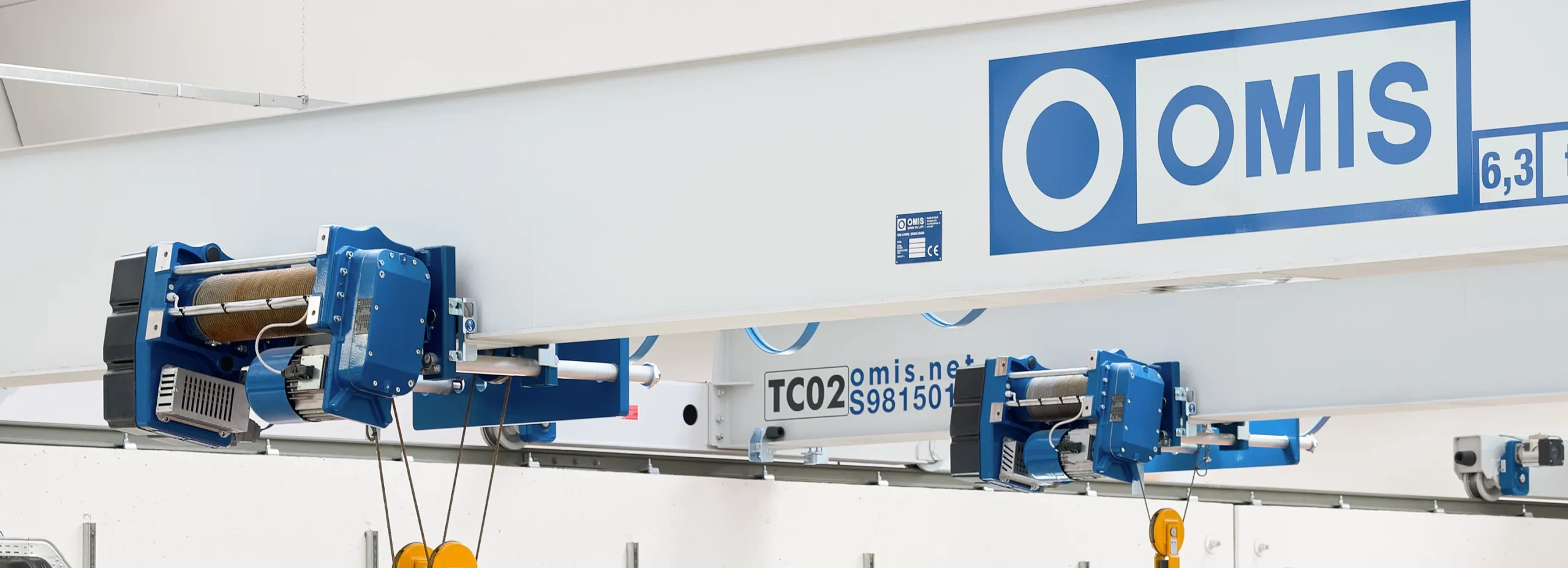
How an electric rope hoist works: components and lifting principle
The electric rope hoist consists of four key components:
- lifting motor
- gearbox
- threaded drum
- steel rope
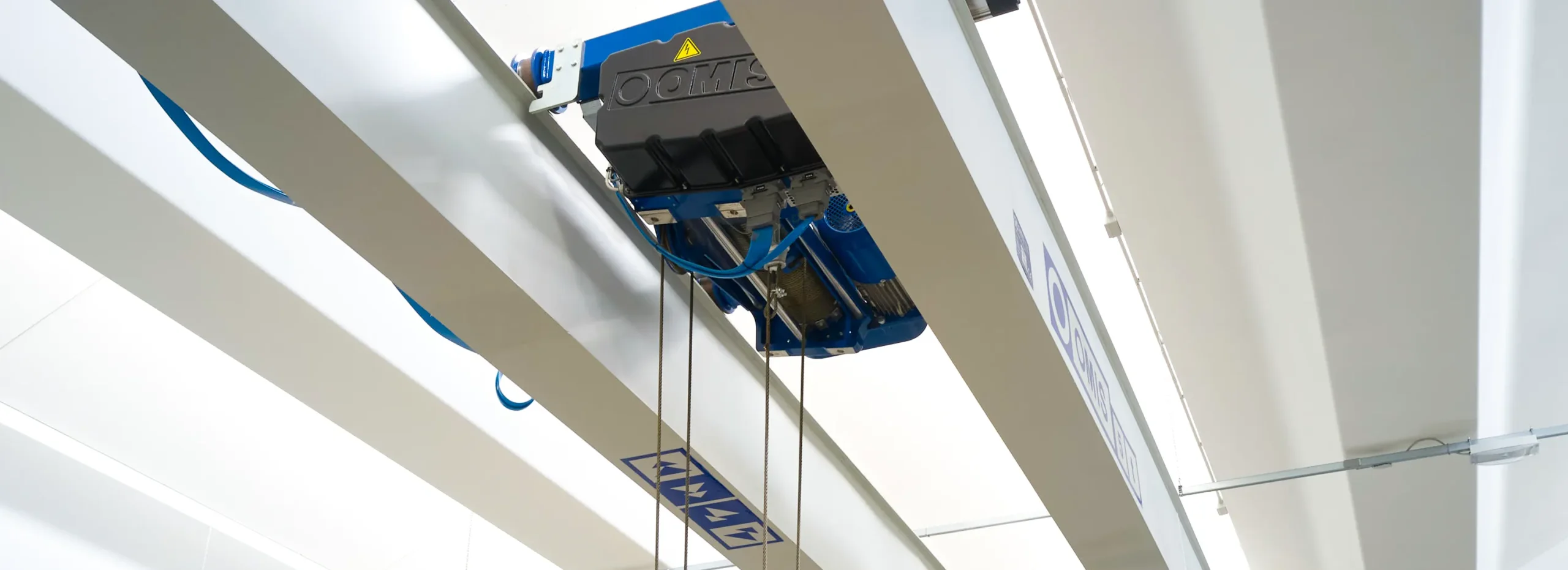
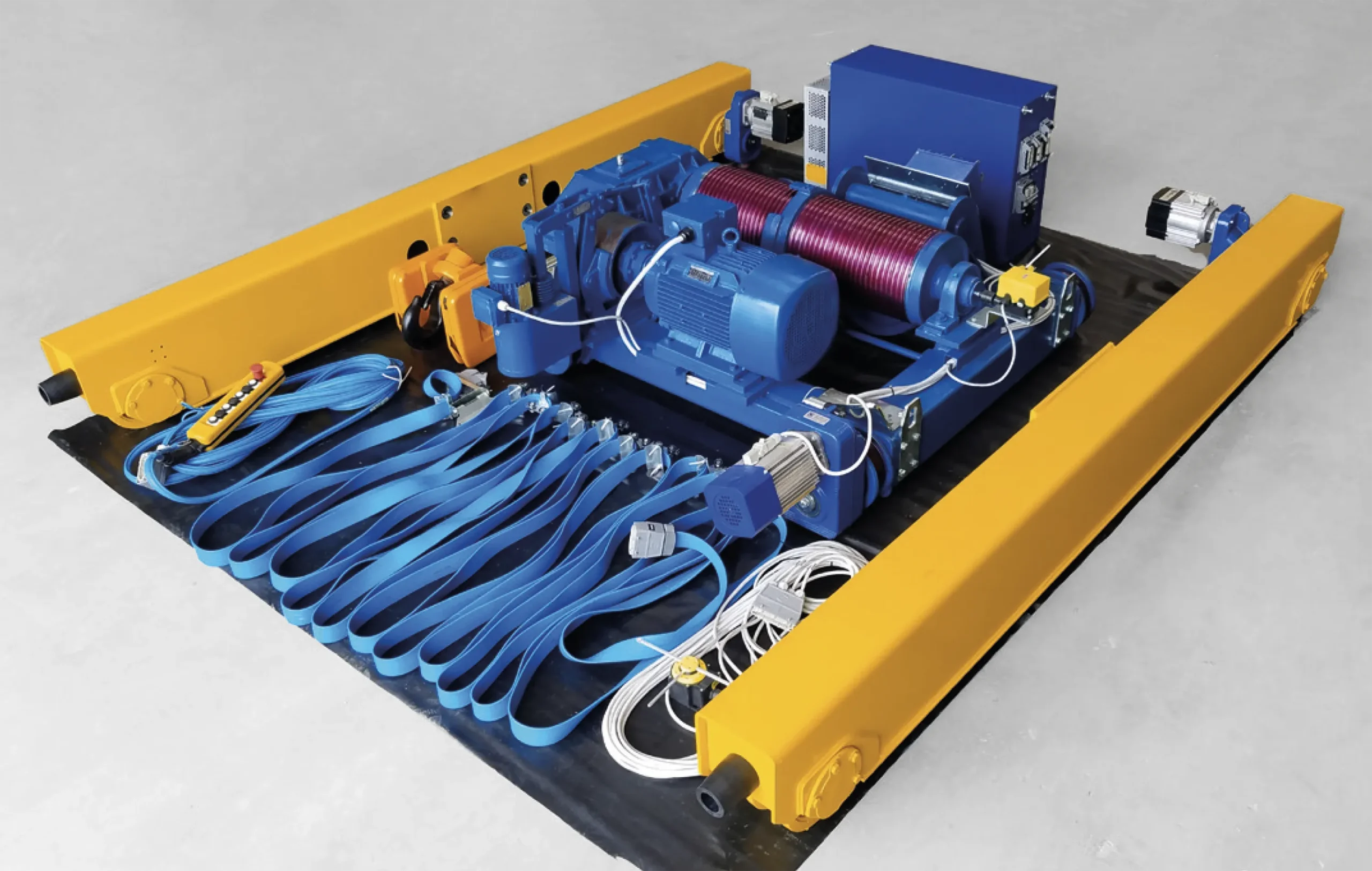
In OMIS Series H hoists, the motor is designed to operate with an inverter, whilst the gearbox is manufactured in-house – a choice that ensures precision and long-term reliability, and quieter operation. The threaded drum ensures even winding of the galvanised rope, which is essential for the safety and durability of the system. Lifting is achieved by rotating the drum: when the motor transmits the motion to the gearbox, the rope winds onto or unwinds from the drum, allowing the hook to rise or lower in a controlled manner. This configuration is the standard design for OMIS H-Series hoists.
Drum, motor and gearbox: the heart of the rope hoist
The frame of the H Series hoist consists aluminium and/or steel components, with a cast-iron rope guide that ensures the correct winding of the rope onto the drum under all operating conditions. The OMIS gear motor is designed and manufactured in-house: a choice that ensures dimensional and electrical compatibility across all available configurations. One feature that sets the H Series apart from its competitors on the market is the standard inclusion of an inverter for all movements. The inverter controls the soft start and the double-speed lifting function, eliminating mechanical jolts on start-up and ensuring millimetre-precise positioning of the load. This is also evident in the quiet operation of the gearbox during manoeuvres, a direct indication of the quality and precision of the construction of the lifting and travel unit. The number of rope falls selected in the configuration determines the relationship between lifting speed and lifting capacity:
- with two rope falls, the lifting speed doubles and the capacity is halved compared with the rated capacity
- the full rated capacity is achieved with 4 rope falls, at the rated lifting speed
The choice between the two options depends on the expected operating cycles and the capacity required by the application.

The trolley: horizontal travel on the overhead crane
The rope hoist travels along the overhead crane girder by means of a motorised trolley. The horizontal movement is smooth and gradual: the inverter also controls the travel, eliminating jerks and abnormal stresses on the supporting structure. The H Series single-girder trolley is designed to fit a wide range of girder profiles. The flange widths (beam flange) supported by the single-girder trolley of the H-Series rope hoist vary depending on capacity.
| Capacity (t) | Products | Beam flange / girder width (min/max) |
|---|---|---|
| From 1.25t to 5t | Rope hoist | 110 mm / 500 mm |
| From 6.3t to 8t | Rope hoist | 140 mm / 500 mm |
| From 8t to 10t | Rope hoist | 150 mm / 500 mm |
| From 10t to 12.5t | Rope hoist | 190 mm / 500 mm |
The H Series is available in seven configurations, covering installations on single-girder and double-girder overhead cranes. In terms of drum orientation, the two standard configurations are the drum parallel to the bridge girders and the orthogonal drum, perpendicular to them.
For the double-girder crane, standard configurations include the suspended version, with the hoist positioned between the two girders, and the reduced-loss version, which minimises the loss of hook height. Both solutions reduce the overall height, making them ideal for warehouses with limited headroom. On the other hand, with the orthogonal drum configuration all the mechanisms are rotated by 90°, reducing the overall dimensions of the trolley and allowing significantly greater lateral hook approach compared with the parallel configuration. It is the preferred configuration when the layout imposes space constraints or requires the hook to be positioned as close as possible to the end carriages. In addition to the double-girder variants described above, the H Series also includes a Stand-Alone version, without trolley, designed to offer maximum installation flexibility. The table below sets out in detail all seven available configurations.
| H Series rope hoist configurations | Products | Operation and characteristics |
|---|---|---|
| Stand Alone | Rope hoist | The ideal choice for businesses requiring a hoist that can be installed freely on existing systems: the H Series hoist in the Stand-Alone version is supplied without trolley, for maximum installation flexibility. |
| Single-girder | Rope hoist | The single-girder trolley designed and built by OMIS at its own facilities allows the travel of the hoist trolley on a single-girder crane, or a monorail. |
| Placed double-girder | Rope hoist | Mounted on a double-girder bridge crane, the hoist is placed on the trolley above the girders to achieve maximum hook stroke. It is possible to switch at any time from placed to suspended configuration and vice versa, to meet new or changed requirements. |
| Suspended double-girder | Rope hoist | Mounted on a double-girder bridge crane, the hoist is suspended from the trolley when the space above the girders is insufficient for the hoist. Also in this case, it is possible to switch between the two configurations at any time. |
| Reduced-loss double-girder | Rope hoist | Identified by the BP acronym, it represents a significant innovation in terms of space requirements: OMIS has optimised the design of the double-girder hoist and created a more compact structure by moving the mechanisms and dislocating the guide pulley. This solution offers greater versatility in spaces with limited headroom. |
| Orthogonal reduced loss double-girder | Rope hoist | The BR version is also available with the drum positioned perpendicular to the bridge girders: as well as allowing for a greater hook stroke, this configuration also permits greater lateral approach. |
| Orthogonal double-girder | Rope hoist | Also available with the drum perpendicular to the bridge crane girders, it optimises lateral hook approach and meets the requirements of a wide range of applications and operating conditions, while maintaining compact dimensions and allowing the hook to be positioned closer to the bridge end carriages. |
OMIS H Series video – Electric Rope Hoist
The H Series in action: standard inverters on all movements and bespoke configurations.
Rope hoist or chain hoist: which unit to choose for the overhead crane
Rope hoist or chain hoist? A common question often asked in the wrong context. The two technologies are not equivalent alternatives; they meet different operational requirements, and choosing the wrong solution will lead to an incorrectly sized system from the outset.
Capacity and lifting height: when the rope beats the chain
The chain hoist is the go-to solution for light-duty and local handling: low-capacity levels, standard lifting heights of up to 6–8 metres, and cycles over short distances. It is the standard choice for jib cranes and lightweight suspended systems.
The rope hoist is, on the other hand, the standard solution for industrial overhead cranes. For loads starting from 1,000 kg or exceeding 1.25 tonnes, rope technology is the technical benchmark for reasons of mechanical stability and long-term wear resistance. The OMIS H Series covers the 1.25 to 12.5-tonne range. For applications requiring particularly high speeds, capacities and duty classes, the correct engineering choice is the OMIS open barrel lifting winch, available in standard configurations from 3.2 to 60 tonnes and above on request. In the 3.2 to 12.5 tonne lifting range, rope hoists and open barrel winches are two equally valid solutions. The choice between the two technologies depends on the specific operating framework: there are numerous parameters that affect the correct configuration of the H Series, which will be analysed in detail in the next section.
How to configure the OMIS H Series rope hoist: capacity, hook stroke and control
Correctly configuring an H Series electric rope hoist means working on several technical parameters simultaneously. Capacity is the starting point, but it is not the only factor that determines whether the unit is actually suitable for the application.
The final configuration depends on the following variables:
- capacity range
- hook stroke
- service class (FEM/ISO)
- number of rope falls (mouflage)
- whether or not the electrical system is fitted on board
- type of trolley (single-girder or double-girder, or fixed hoist, without trolley)
These elements all contribute to defining the final product. In this section, we analyse each variable in the H Series, starting with the capacity.
From 1.25 to 12.5 tonnes: hoist capacity range and hoist variants
The H Series electric rope hoists cover the most common load range in manufacturing departments: from 1.25 to 12.5 tonnes, for both single-girder and double-girder overhead cranes. Within this range, the actual safe working load (SWL) also depends on the reeving configuration (mouflage), i.e. the number of rope falls selected during the configuration:
- 2 rope falls correspond to higher speed and halved the capacity
- 4 rope falls correspond to nominal capacity and nominal speed
The choice depends on the expected operating cycles and the average operating load. Every unit in the H Series is designed, manufactured and tested in-house at the OMIS premises, in a production facility exclusively dedicated to this range. This vertical integration ensures reliable lead times, consistent quality and full traceability.
When operational requirements call for capacities in excess of 12.5 tonnes, or particularly high duty classes and speeds, the standard hoist design gives way to the OMIS open barrel lifting winch, available in configurations of up to 60 tonnes, and above on request.

Hook stroke: standard travel distances and adaptation to the height of the factory shed
The hook stroke is the vertical distance travelled by the hook between its lowest and highest positions. This depends on the clear height of the shed and the structural constraints of the equipment, and must be determined before the unit is configured.
The standard hook strokes for the H Series are:
- 6 m and 10 m for small and medium sizes (H10, H20, H30)
- 8 m and 12 m for the large size (H40)
In the Italian manufacturing sector, the most common travel distance is around 7–10 metres, a range that the OMIS electric rope hoist covers as standard without the need for bespoke modifications. A typical example is a mechanical workshop with a clear height beneath the girder of between 6 and 10 metres: the H Series can be configured to the correct stroke without requiring any structural modifications to the existing system. For particularly tall sheds or special installations, the two-rope configuration extends the hook stroke beyond the standard values, whilst halving the capacity.
Control system: push-button strip, radio remote control, datalogger and electrical panel
The control system is the operating interface of the hoist. The H Series offers a range of solutions, which can be configured to suit the layout of the department and specific usage requirements:
- Wired push-button strip (standard option): with plug&play connection and IP65 protection against dust and water jets, it is ideal for the most common industrial environments.
- Radio control (optional): suitable for work areas where the operator needs to move around whilst manoeuvring, or where visibility of the load is limited. By eliminating cable constraints, they enhance safety and freedom of movement, even in complex layouts.
- Datalogger (optional): a device that constantly monitors loads and usage cycles. The data collected is essential for scheduled maintenance and for verifying the FEM class.
- Integrated electrical panel: a truly distinctive feature of the H Series. Compact and integrated directly into the structure, it houses all the control components. It is fully tested and inspected at OMIS and is DNV ISO 9001 certified.
Special environments and optional extras for non-standard operating conditions
The H Series electric rope hoist is designed to operate in a wide range of environmental conditions. For installations in specialised environments, OMIS offers a range of models and optional extras that extend the operational capabilities of the rope hoist well beyond the typical conditions found in a conventional manufacturing department.
Optional extras include:
- temperature sensors to monitor the motor temperature, and anti-condensation heaters to protect the electrical components
- outdoor version with protective canopies to shield against the elements
- LED spotlight integrated into the trolley with adjustable tilt: it improves visibility in shady areas or particularly dark environments, with direct benefits for the precision and safety of the operation
- devices for areas where the passage of loads is prohibited, compliant with current regulations, are particularly relevant in applications where crane operation takes place near fixed workstations or controlled-access areas.
- Encoder (safety and low speeds): measures motor revolutions and acceleration for precise motor control, maintaining a constant speed as the load varies and signalling any faults, with benefits in terms of energy efficiency and operational safety
Every environment has its own operational requirements. Check which versions and optional extras of the H Series are compatible with your application and configure your OMIS electric rope hoist
Regular inspections and service life: how often should a rope hoist be inspected
The service life of an electric rope hoist is not measured in years, but in cycles. The EN 14492-2 European standard and the FEM standards specify, for each lifting class, the maximum number of lifting cycles within which the lifting unit may operate safely. A limit that must never be exceeded: when the counter reaches 100 per cent of the service life of the lifting system as a whole, replacement or a general overhaul is mandatory.
The physical symptoms of the end of life
Extraordinary inspections carried out as part of residual service life analyses (SWP – Safe Working Period) are used to identify cracks and fissures in structural steelwork and welds. The difficulty in sourcing original spare parts should not be underestimated either: a hoist that is no longer in production, with a supply chain that cannot be traced, exposes the system to unplanned downtime and repairs using uncertified components. Combining visual observation with objective data reduces the margin of error. The datalogger, available as an OMIS option, records cycles, operating hours and load profiles through a system fitted with a load display. In this way, the residual service life is no longer an estimate, but a value that has been measured and documented in accordance with FEM standard 9.755 and ISO standard 12482-1. Continuous monitoring also reduces the dynamic coefficient in the calculation of service life, extending the interval for in-depth inspections from 10 to 20 years of service.

Revamping and compatibility: installing the H Series electric rope hoist on an existing overhead crane
When a rope hoist reaches the end of its service life, the supporting structure of the overhead crane is often still in good working order. In such case, it is possible to carry out work solely on the lifting system by undertaking a revamping project, which typically involves replacing the lifting system, the electrical system and the festoons, or restoring the performance of a system that is still serviceable. If the work involves technological modernisation (electrical panel, inverter, control system, as well as hoist or open barrel winch, trolley and power supply line), the term retrofit is more accurately used; this is the term predominantly used in German-speaking markets (Nachrüstung). The situation is different when it comes to replacement: i.e. the supply of a brand-new, complete machine. However, revamping is not an automatic choice, nor is it always the most cost-effective option: a technical and economic assessment must be carried out on a case-by-case basis and confirmed by an inspection of the existing structure. When the structural steelwork no longer complies with regulations, the layout has changed or the required capacity has increased, the right solution may be a new overhead crane.
The OMIS team can assess both solutions and recommend the most suitable one, without taking either for granted.
Compatibility with the existing structure
The H Series electric rope hoist is designed to be installed on structures from any manufacturer, thanks to a range of single-girder trolley configurations covering flange widths from 110 mm to 500 mm, depending on capacity.
This compatibility is universal: the OMIS revamping service is not tied to the original crane brand, but still guarantees full compliance and compatibility. Every H Series unit is manufactured in an entirely Italian production chain, bringing together design, gearbox, electrical panel and final testing within a single production ecosystem certified to ISO 9001 by DNV. This ensures the traceability of every component and eliminates the risk of dimensional variations or electrical incompatibilities that may arise with units assembled from untraceable supply chains.
The revamping does not only concern the lifting mechanism. In many existing systems, the control system is the real critical issue:
- obsolete electrical panels
- no inverter
- radio controls that do not comply with current standards
OMIS combines the replacement of the rope hoist with the complete modernisation of the electrical panel and control system, with the option of integrating radio control and dataloggers into systems that were previously without them. Installing an H Series hoist on existing structural steelwork may also be a more cost-effective alternative to supplying a complete new overhead crane: the OMIS team analyses both options and identifies, on a case-by-case basis, the solution best suited to the operational context.
Beyond the individual component: when to choose an OMIS overhead crane kit
A technical assessment of the revamping requirements may show that the hoist is not the only component that needs to be replaced. In these cases, OMIS supplies complete overhead crane kits that as a rule include all the components making up an overhead crane, with the exception of the bridge girders:
- end carriages fitted with gear motors and connection flanges
- lifting unit (hoist or open barrel winch)
- electrical panel
- complete electrical system
- girder construction drawings and wiring diagrams
All components are manufactured to OMIS quality standards and tested before shipment. The assembly is designed to simplify installation, with a single supply that reduces assembly times, optimises logistics and ensures native compatibility between all system components. The kits are available to small manufacturers, distributors and service centres worldwide: discover the OMIS overhead crane kits.
FAQ - Frequently Asked Questions
- How does the hoist move along the overhead crane?
The electric rope hoist travels along the main girder of the overhead crane by means of a motorised trolley. The rope hoist trolley for single-girder overhead cranes is designed to fit a wide range of girder profiles, with supported flange widths varying depending on capacity: from 110 mm to 500 mm on single-girder trolleys for units from 1.25 to 5 t; up to 2000 mm on double-girder trolleys for units from 10 to 12.5 t. The H Series is available in configurations for single-girder and double-girder overhead cranes, with the drum positioned either parallel to the crane girders or perpendicular to them.
- Rope hoist or chain hoist, which one should one choose?
The choice depends on the operational limits in terms of capacity, lifting height and the demands of the application: the chain hoist is suitable for capacities of up to 5 t and low lifting heights (max. 6–8 m); it is the ideal solution for frequent cycles over short distances and close-proximity handling. Rope lifting, using a hoist with a capacity of up to 12.5 t and an open barrel winch with a capacity of up to 60 t (and above on request), covers heights of up to 20 metres (with the option of extension) and is the standard choice for most industrial overhead cranes or for kits intended for small distributors and manufacturers worldwide. For heavy loads above 5 t on overhead crane, rope technology is the technical benchmark for reasons of mechanical stability and mechanical wear.
- What capacity should I choose for my overhead crane’s rope hoist?
The capacity must cover the maximum working load (SWL) plus a safety factor. OMIS H Series electric rope hoists are designed to handle loads ranging from 1.25 to 12.5 t and can be configured for both single-girder and double-girder systems. For heavy-duty industrial applications with capacities exceeding 12.5 t on double-girder overhead cranes, the correct engineering solution involves switching to the OMIS open barrel winch lifting system, which can handle loads of up to 60 t and beyond on request, and is capable of ensuring a perfectly centred pull thanks to its double-reeved versions.
- When is it advisable to replace the hoist on an old overhead crane?
It is recommended that the rope hoist be revamped or replaced once it has exceeded 100 per cent of the system’s theoretical FEM service life. The remaining service life of the hoist is calculated by combining the recorded operating hours with the historical distribution of the loads lifted, and comparing these with the design FEM classes. The intervention becomes cost-effective when the repair costs exceed 40–50 per cent of the cost of replacing with a new unit. For the German market, the DGUV Regulation 52/54 requires an additional in-depth inspection after 10 years of service.
- Where is the OMIS H Series hoist manufactured?
The H Series hoist is designed and manufactured entirely in Malo (Vicenza, Italy), at a factory dedicated exclusively to this range. Every unit is supplied with DNV ISO 9001 certification, with full traceability for every component produced.
- How often should a rope hoist on a bridge crane be inspected?
A rope hoist on a bridge crane must be inspected at least once a year by qualified personnel. In Germany, the DGUV Regulation 52/54 and the BetrSichV require this inspection to be carried out by a competent body such as ZÜS; in Italy, Legislative Decree 81/2008 also requires the rope to be inspected every 3 months, whilst the other components (hook block, pulleys, brake system, motor, wheels) are inspected at the intervals specified in the manufacturer’s manual, typically annually for OMIS hoists. In both cases, once the unit has been in service for more than 10 years, an additional in-depth inspection of its ageing condition and remaining service life is mandatory, with full traceability documented in the maintenance log (Prüfbuch in Germany).
As we have seen, choosing the right electric rope hoist for an overhead crane requires a careful analysis of the existing structure, the actual operating cycles, the environmental conditions and the department’s productivity targets. For over 55 years, OMIS has been designing, manufacturing and installing lifting systems for industrial plants of all sizes: every configuration is the result of a thorough technical analysis, carried out by those who know these products inside out. For existing systems, OMIS Service supports the customer at every stage: from the compatibility assessment through to installation and scheduled maintenance. Would you like to check whether the H Series is compatible with your overhead crane?