
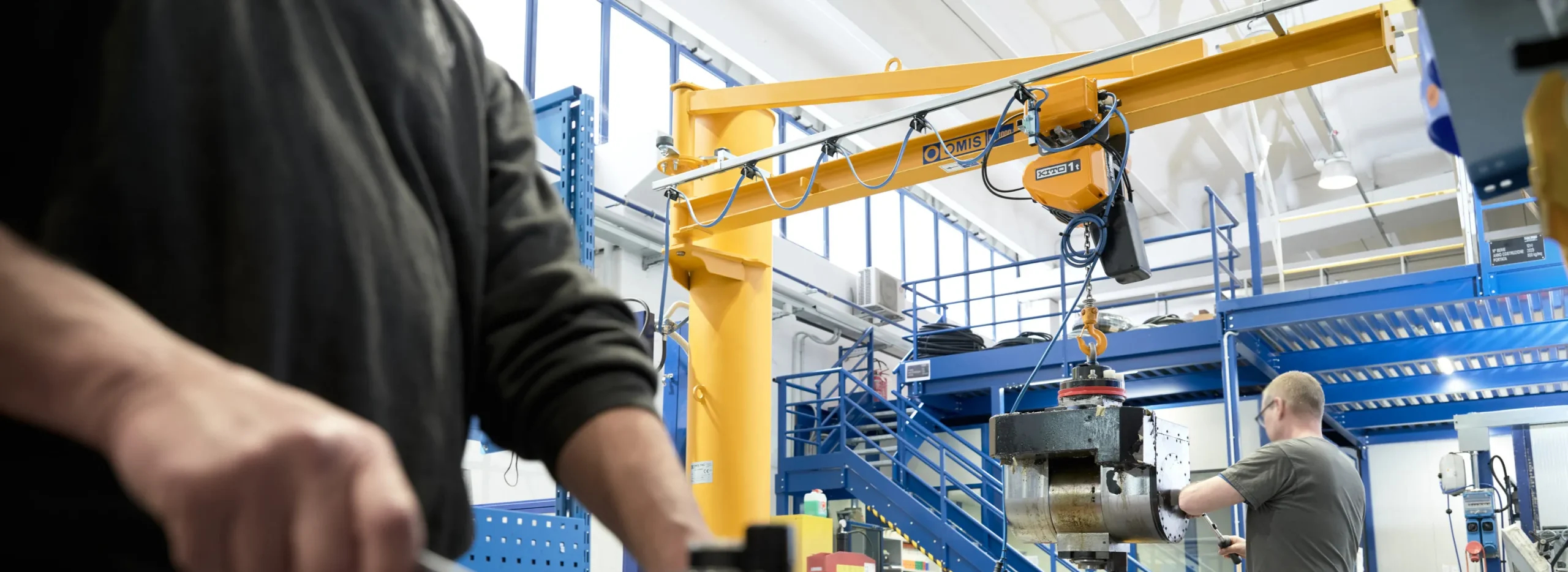
Jib cranes: operational flexibility in industrial departments
In the field of lifting systems, the jib crane is a fundamental piece of equipment. Versatile, economical, and suitable for capacities ranging from a few tens of kilograms up to several tonnes, the jib crane - described by engineers as the 'underdog' of the industry - is probably the most widely used handling system in the world in production facilities of all sizes, from the craftsman's workshop to the large multinational industry. And often the most overlooked. At OMIS, we have been designing lifting systems since 1967 with one objective that has never changed: "Born to Lift". In this article, we explain everything you need to know to choose, install and maintain the right jib crane for your department.
What is a jib crane and why it is the ideal solution for the workstation
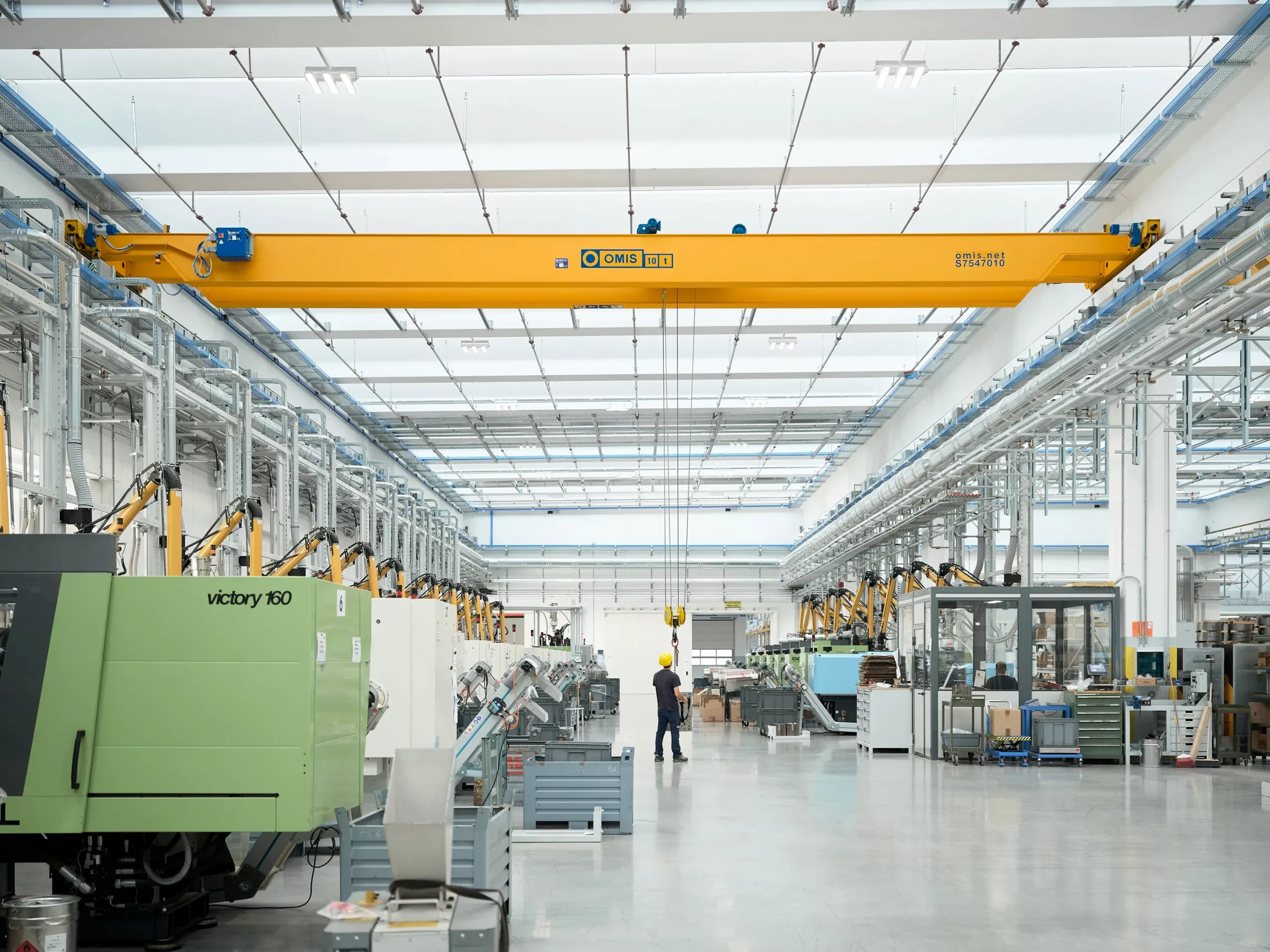
The jib crane is a lifting system dedicated to a single work area: limited operating radius, immediate movements, direct control by the operator using it. The difference with the overhead crane lies in the range of action: the overhead crane is a system that serves the entire span of the plant, designed for heavy movements and transfers between departments. Installing a jib crane does not mean replacing the overhead crane but complementing it. The operator independently manages handling activities at close range, while the overhead crane remains free for heavy loads and transfers between different work cells. The result is a system where every piece of equipment works within its optimal range: reduced waiting times, faster workflows, increased safety thanks to more limited and more controlled movements.
Components of a jib crane: structure and main elements
Every OMIS jib crane is the result of precise engineering choices for each component. Understanding its structure helps identify which version best meets one’s own specific operational requirements.
- Boom: the horizontal element that rotates and supports the load. It determines the operating radius of the workstation; it can be rigid or articulated: the articulated version allows operation in the presence of fixed obstacles, optimising the footprint in very confined spaces.
- Column or bracket: the load-bearing element that defines the type of anchoring. In addition to the free-standing pillar crane and the wall-mounted crane, our range includes the mobile plinth crane. At OMIS, we see it as a variant of the column structure, designed for those who need stability without the constraints of permanent fixation.
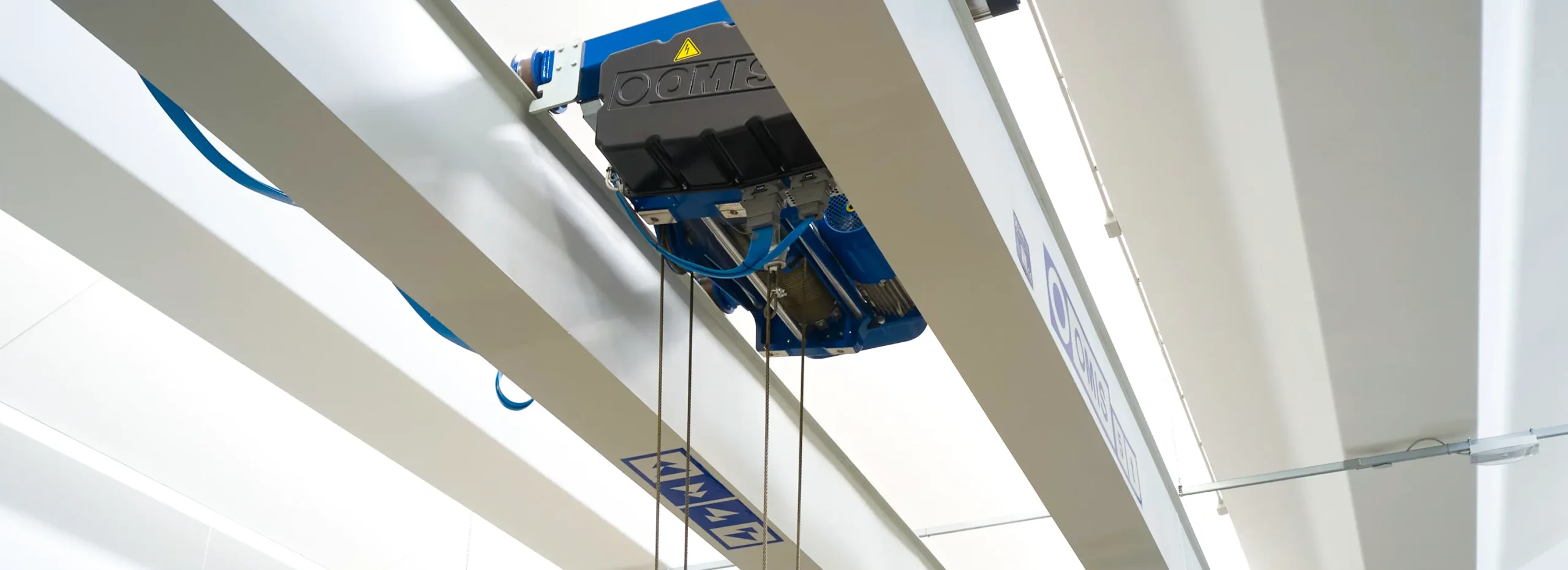
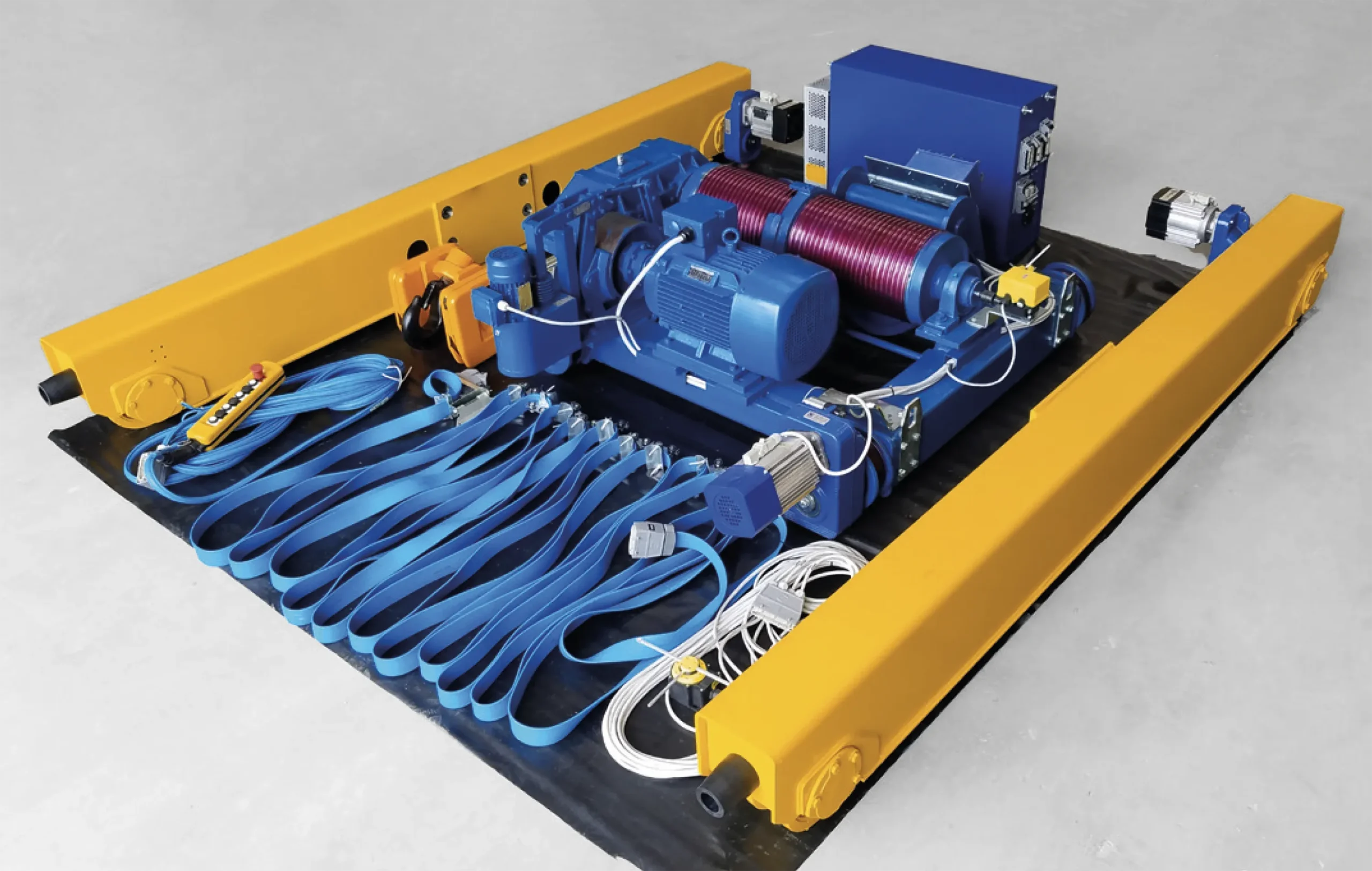
- Trolley and hoist: the hoist – chain or rope hoist – slides along the boom via a trolley. It is the heart of the lifting system: its choice depends on the required capacity, frequency of use and operating environment.
- Rotation mechanism: manual for direct and responsive control, motorised for large loads or precision positioning. The angle can be configured according to the available space; some configurations achieve full 360° rotation.
Identifying the components is only the first step. The real design challenge lies in making them work together in harmony. In the next paragraph, we will see how the combination of capacity and boom geometry determines the real effectiveness of your installation.
Pillar, wall-mounted and mobile plinth jib cranes: which configuration for each situation
The supporting structure is not a secondary detail: it defines the operating area, the impact on the existing layout and – an often-underestimated aspect – the technical constraints of the installation site. The three main jib crane configurations respond to different needs and are not interchangeable: the correct choice depends on context analysis, which comes even before commercial preference. The movable plinth version is our answer to dynamic layouts and, above all, to flooring suitability issues. If the floor does not allow fixed anchoring, the reinforced concrete base guarantees stability and allows the system to be moved with a simple forklift or overhead crane. The structural setup defines where and how the crane is installed. But once the type of support has been defined, the second design variable comes into play: boom geometry. This is where the jib crane shows all its operational flexibility.

| Anchoring | Products | Rotation |
|---|---|---|
| Floor | Pillar jib crane with channel-shaped profile boom | 360° |
| Pillar or wall | Wall-mounted jib crane with channel-shaped profile boom | Up to 270° (configurable) |
| No fixed anchoring | Pillar jib crane with channel-shaped profile boom and movable plinth | Up to 270° |
Jib crane types: which configuration for each production environment
Every department has its own layout and constraints: the correct approach starts from there. To explore the options, one must distinguish between two independent variables: the geometry of the boom and the rotation system. Paired with the right hoist, the correct combination of these two elements is what transforms a jib crane into a tool geared for real productivity.
Boom in channel girder, cantilever boom and boom with tie rods: the three basic geometries
The boom geometry determines maximum capacity, available extension and vertical footprint of the system. The 2000 kg threshold is the most common reference in mechanical workshops and CNC departments: the following table summarises the differences between the three main configurations to guide the choice.

| Ideal context | Products | Operation |
|---|---|---|
| Light repetitive cycles | Pillar jib crane with channel-shaped profile boom | Manual, smooth |
| CNC, assembly, loading/unloading | Pillar jib crane with cantilever girder boom | Manual or motorised |
| High capacities and long extensions | Pillar jib crane with girder boom with tie rods | Manual or motorised |
Articulated boom and double boom: agility and autonomy in complex spaces
In departments with closely spaced columns, bulky machinery or blind corners, the articulated boom jib crane is the correct technical answer. Consisting of two hinged segments, it makes it possible to circumvent fixed obstacles while maintaining fluidity of movement. It is the benchmark configuration for those looking for a jib crane for tight spaces without sacrificing capacity.
The technical characteristics that make this system unique are:
- Two-segment hinged structure: the boom consists of two hinged segments on bearings, capable of rotating independently of each other.
- Double combined rotation: the system guarantees optimal manoeuvring width, with 240° rotation on the first boom (the one tied to the column) and 300° on the outermost boom.
- Maximum height: the OMIS design does not include any tie rods above the boom, an engineering choice aimed at exploiting the full height of the room and maximising hook stroke.
- Configuration of the lifting unit: the hoist is normally installed fixed at the end of the boom for quick movements. Upon request, it can be installed on a sliding trolley for even greater precision.
Our experience in production departments has led us to develop this technology to cover capacities ranging from 125 kg to 1000 kg, guaranteeing excellent manoeuvrability even in the most intensive work cycles.

The 'double boom' option: double the productivity in half the space
To further optimise the investment, the articulated boom is also available in a double version: a practical and economical solution for making two adjacent workstations autonomous, which would otherwise require the installation of two separate cranes. Using a single column with double extension reduces the footprint of the system, leaving more free space for the circulation of materials and operators.
Manual or motorised rotation: capacity and duty cycles guide the choice
Rotation is a characteristic independent of boom geometry. It must be evaluated separately based on two parameters: load weight and frequency of use. The manual version guarantees direct control and immediate responsiveness. It is suitable for light loads, where the operator prefers to personally manage the movement trajectory. The motorised version comes into play when the load is important and ergonomics are a priority. Combined with an electric hoist, it transforms the jib crane into a fully assisted system, reducing physical effort to zero. The angle of rotation – standard 270°, extendable up to 360° continuous – should be defined according to the available operating space.
The opinion of the OMIS technician: “An undersized system accelerates component wear and increases safety risks; an oversized one is less responsive and more difficult to manoeuvre. The objective is to size the system according to real productivity, not theoretical peak values.”
Find the right configuration for your department. Capacity, extension, boom geometry, rotation system: enter the actual parameters of your installation in the OMIS configurator and get your customised technical specification.

Jib crane applications: from production departments to logistics warehouses
The jib crane is probably the most versatile lifting system available. It is not a system for large plants or specific sectors: it is the ‘passe-partout’ of industrial handling, suitable for any context where loads need to be moved in a timely, ergonomic and safe manner. From the crafts workshop handling components weighing only a few kilograms, to food, wine-making, chemical, pharmaceutical, or military plants lifting tonnes: the OMIS range covers the entire spectrum of production requirements.
Mechanical Workshops and CNC Machining Centres
The use in mechanical workshops is the most widespread application. It oversees the loading and unloading of CNC machining centres, lathes, milling machines and grinders, allowing the operator to position parts with direct control and reduced cycle times, without waiting for the department overhead crane. It supports the transfer of semi-finished products between consecutive stages.
Assembly lines and production lines
In assembly lines and production lines, it reduces physical effort during mechanical coupling and component positioning. Each workstation becomes autonomous, the work cycle is not interrupted waiting for external equipment, and production flows without delays.
Warehouses and Logistics
In warehouses, it is the ideal choice for handling big bags, heavy picking activities and loading/unloading automatic vertical warehouses. The speed of execution and limited radius of operation make it complementary to automated storage systems, where every second waiting translates into inefficiency.
Special environments: food, wine, chemical and pharmaceutical
In these sectors, the determining factor is not capacity, but the specifications of the environment. In the food and wine-making sectors, galvanising, special coatings and – where required – stainless steel guarantee hygiene, corrosion resistance, and compatibility with sanitation protocols. In corrosive environments, every component – from the hoist to the rotation mechanism – must be certified for the specific installation conditions. In both cases, preliminary technical consultancy is not optional: it is the step that determines the feasibility and safety of the system.
Light and repetitive handling: integration with vacuum systems
For packaging operations or repetitive handling of light loads – generally under 50 kg – where speed of execution is extremely high, the jib crane integrates with vacuum lifters and vacuum tube lifters that completely eliminate physical effort for the operator and expand the operational possibilities of the workstation without modifying its structure. At OMIS, we have seen that speed and high frequency are the most immediate advantages, but they are not the only parameters to consider. Equally critical are a gentle approach, necessary to avoid damaging fragile surfaces, and the ability to handle bulky loads such as panels, sheets or bags in complete safety. These factors vary considerably from sector to sector: what is crucial in food or pharmaceutical applications may differ radically from the requirements of a mechanical workshop. Choosing the right system always starts with analysing the real context.
How to choose the right jib crane: technical parameters and installation criteri
If you would like to learn more about how to design an ergonomic and efficient workstation, read also how to design safe and ergonomic workstations.
Choosing a jib crane does not mean purchasing a standard machine but designing an extension of the operational capacity of the work area. It is a decision that starts with the assessment of the real context – weights, spaces, frequencies, structures – and requires technical expertise before even considering a product catalogue. The evolution of the OMIS jib crane reflects this flexibility: from 125 kg manual crane systems for crafts workshops to systems with capacities of several tonnes for shipbuilding and military construction sites, each configuration is the result of a specific analysis. There is no one-size-fits-all solution. There is the right size for every context.
Capacity and extension: the two decisive parameters
The first two parameters to be defined are capacity and extension. They must be assessed together, rather than separately: a large operating radius combined with a significant load generates considerable stress on the system, which must therefore be sized accordingly. The OMIS range covers capacities from 125 kg up to 6000 kg – and more on a project-specific basis – with extensions of up to 8 metres. To guide the choice:
- Light loads (up to 250 kg): immediate and responsive action, low inertia, ideal for high frequency cycles. Manual operation is effective and ergonomic.
- Medium loads (250 – 1000 kg): balance between speed and control. Manual control is still feasible but requires attention to inertia management. Motorised rotation is starting to become a recommended choice.
- Heavy loads (over 1000 kg): dynamics become strongly controlled. Electric hoists and motorised rotation are not optional extras: they are essential requirements for safe and precise lifting.
An often-overlooked parameter is the duty cycle: the utilisation classification that considers not only the maximum capacity but also cycle frequency and the average load actually handled. A system sized for 2000 kg but used for repetitive handling of 250 kg loads will be unresponsive and cumbersome. The opposite mistake – ignoring intensive use on light loads without suitable components – leads to premature wear and unplanned downtime.
Wall, column, or plinth installation: what to check first
Every jib crane configuration assumes specific site requirements. This is the point where assessment errors are most frequently made – and where the experience of the technical partner makes the difference.
- Wall-mounted installation (wall-mounted crane): section depth, structural integrity and ability to absorb the torsional moment generated by the cantilever load must be verified.
- Pillar installation (self-supporting crane): the concrete thickness and strength class must be able to withstand the bending moment of the loaded column. If the flooring is unsuitable, a reinforced concrete foundation plinth sized according to the project is required.
The choice depends on site conditions, not aesthetic preference. The preliminary technical inspection is the step that determines the feasibility and safety of the installation.
Preventive structural analysis: a valuable investment
When an OMIS technician states that a structural site assessment is required before installation, the most common reaction is surprise. It is often perceived as an unnecessary expense, an obstacle between the order and the operational system. It is not. A crane installed on an unverified support may appear to operate correctly for weeks. Then the first issues appear, such as vibrations or cracks in the support. In the worst cases, structural failures with direct consequences for safety and productivity. Relying on a documented analysis is the only way to protect the investment and avoid unexpected downtime or extraordinary repairs. It is useful to remember that the stability analysis is proportional to the system: for light systems on standard flooring, it is often completed very quickly. OMIS professionals guide the customer through every step, from the preliminary site assessment to commissioning, regardless of installation size.
Jib crane integrated with overhead crane: designing the complete system
The jib crane does not replace the overhead crane. In a well-designed industrial layout, the two systems work in synergy, each within its optimal scope. The overhead crane handles heavy lifting and transfers between departments or bays. The jib crane oversees the individual cell, eliminating waiting times and making every work area autonomous. The result is a continuous production flow with no bottlenecks and no overhead crane overload. A concrete example of this approach is the case of Nexteel, where OMIS designed an integrated system of 50 installations, including jib cranes, portable gantry cranes and overhead cranes, transforming the production layout and making the individual workstations independent.
Designing the right system is the first step. The second is to ensure that everything that follows the installation – from commissioning to periodic checks – is handled with the same precision.
Jib crane regulations: safety, obligations and periodic inspections
In Italy, the installation of a jib crane marks the beginning of a safety management process governed by precise legislative obligations. Ignoring these steps not only jeopardises the validity of the guarantee: it exposes the company to penalties and, above all, puts at risk the safety of operators.
Note: this section refers to current Italian legislation. Lifting equipment legislation may differ in other European and non-European countries.
Commissioning and INAIL notification: who does what
The division of responsibilities is clear and must be understood before installation. OMIS’ responsibility: system testing and technical commissioning. Upon completion of the installation, OMIS certifies that the crane complies with the design specifications and applicable product standards, including the CE marking. Customer’s responsibility: the physical installation of the crane – meaning site preparation and anchoring – and notification to INAIL (Italian National Institute for Insurance Against Accidents at Work) through the CIVA (Certification and Verification of Systems and Equipment) portal. According to Legislative Decree 81/08, every lifting equipment with a capacity of more than 200 kg must be notified to INAIL, which assigns a serial number to the equipment and is responsible for the first periodic inspection. After registration, within the legal deadlines, the customer must request the first inspection from INAIL, indicating the preferred accredited body; INAIL may conduct the inspection with its own personnel or appoint the body chosen by the user.
Regular inspections: frequency, authorised parties and maintenance register
After the first inspection, the system enters the periodic inspection regime, with inspections every two or three years depending on the risk profile certified by INAIL. Inspections may be entrusted to public or private entities authorised to do so, in accordance with Article 71, Paragraph 11 of Legislative Decree 81/08. Every inspection – and every maintenance activity – must be recorded in the maintenance register of the system, a file collecting documentation certifying the history of the equipment, tracking replacements of critical and non-critical components – ropes, chains, hooks, slewing ring – and demonstrating the status quo during inspections.
OMIS Service: scheduled maintenance as an investment in productivity
Maintenance is not a fixed cost: it is an insurance of production continuity. Unplanned downtime in a work cell always impacts production more than the cost of a scheduled inspection plan. OMIS Service offers a service that goes far beyond visual inspection, with the same attention regardless of the size of the system: whether it is a 125 kg crane in a crafts workshop or an integrated system in a large facility, every intervention produces a detailed technical report documenting the condition of every inspected component: lifting units, chains, trolleys, structure, rotation pin, electrical system. Not a generic checklist but a document that captures the real condition of the system and the necessary corrective actions with the same precision with which a car workshop certifies the condition of a vehicle after servicing. This level of documentation is not only useful for regulatory compliance: it helps customers make informed decisions regarding the useful life of the system and plan future investments without surprises. OMIS Service plans include scheduled routine maintenance, assistance and emergency response, revamping of existing systems and supply of original spare parts.

FAQ – Frequently asked questions about jib cranes
- What is the maximum capacity of an OMIS jib crane?
The range starts from 125 kg for light high-frequency solutions, up to 6000 kg for heavy-duty applications – and beyond on a project-specific basis. The choice depends on nominal load, frequency of use and required extension: three parameters that must always be evaluated together. There is no need to oversize unnecessarily: our technicians will help you find the perfect balance between cost and performance.
- What capacity should I choose for my application?
In addition to weight, consider cycle frequency: for intensive use, it is useful to choose a slightly higher load capacity to reduce wear, vibrations and operator effort. The OMIS configurator allows you to set these parameters and get a customised evaluation.
- How is a wall-mounted jib crane installed?
It requires a documented verification of the existing pillar or wall. A visual assessment is not sufficient: an analysis certifying the ability to absorb the torsional moment generated by the cantilever load is required.
- Can I install a jib crane on any floor?
No. Concrete thickness and strength class must be verified. If the flooring is unsuitable, a dedicated reinforced concrete plinth is required or, alternatively, the mobile plinth solution.
As we have seen, investing in a jib crane means transforming every workstation into a strong productive asset. It is not just a matter of lifting loads, but of eliminating downtime and interference between workstations, giving the operator total autonomy and safety. This is the efficiency measured in completed work cycles: freer operators and systems that never stop.
The right jib crane for your department exists: whether you have a crafts workshop or a large facility, OMIS is available to help you find it together.